
Resources
110V vs 240V Site Transformers Explained
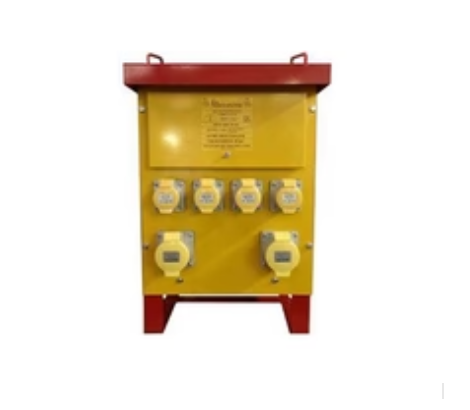
Power distribution on construction and industrial sites in the UK is governed not just by performance needs, but by strict safety standards. One of the most important distinctions is between 110V and 240V power, and the role that a site transformer plays in delivering safe, reliable electricity to tools and equipment.
Understanding the difference between 110V and 240V systems — and when each is appropriate — is essential for maintaining compliance, protecting workers, and ensuring reliable operation across active sites.
Why UK Building Sites Use 110V Power
On UK construction sites, 110V power is the standard for portable tools and temporary electrical systems. This is primarily due to its improved safety profile.
Most site setups use a centre-tapped 110V system, where the voltage is split into two 55V lines relative to earth. This significantly reduces the risk of electric shock. If a person comes into contact with one live conductor and earth, the maximum voltage they are exposed to is 55V rather than the full 230–240V mains supply.
This reduced-shock-risk principle is why 110V transformers are widely used on construction sites, particularly where:
-
Equipment is used outdoors
-
Conditions are wet or unpredictable
-
Cables and tools are subject to wear and damage
-
Multiple workers are operating equipment simultaneously
In these environments, lowering voltage is one of the most effective ways to reduce the severity of electrical accidents.
What a Site Transformer Does
A site transformer is used to convert standard UK mains voltage, typically 230–240V AC, into a safer, lower voltage — most commonly 110V — for use on-site.
In many cases, a 110V site transformer acts as a step down transformer 240V to 110V, allowing contractors to safely power portable tools, temporary lighting, extension leads, cable reels, and other site equipment.
Its key functions include:
-
Voltage step-down: Reduces mains voltage to a safer level suitable for site tools
-
Electrical isolation: Separates the output circuit from the input supply, adding an extra layer of protection
-
Robust power distribution: Designed to handle demanding site conditions, including heavy loads and rough handling
These transformers are typically portable and rugged, making them suitable for temporary installations and mobile use across construction sites.
Key Differences Between 110V and 240V Transformers
While both 110V and 240V transformers serve important roles, they differ significantly in how they are used and the benefits they offer.
Safety
110V systems are much safer for active site use due to reduced shock risk. 240V systems carry a higher risk and are generally restricted to controlled environments.
Power delivery
240V can deliver more power efficiently with lower current, making it suitable for high-load equipment. 110V systems require higher current for the same power output, which is why choosing the correct transformer rating is important.
For heavier site loads, a 10kVA site transformer may be required to support larger equipment or multiple tools operating at the same time.
Cable requirements
Because 110V systems draw more current, they often require thicker cables to minimise voltage drop and overheating. 240V systems can use thinner cables for equivalent power.
Typical applications
Common applications include:
-
110V site transformers: Portable tools, temporary lighting, cable reels, junction boxes, and general site equipment
-
240V systems: Fixed installations, workshops, office units, and certain heavy-duty machinery
-
Single phase transformers: Smaller site setups, workshops, and standard power distribution requirements
-
3 phase transformers: Larger industrial sites, heavy-duty equipment, and higher-capacity power distribution
In practice, 110V is prioritised for safety on active sites, while 240V is used where conditions are more controlled.
Choosing the Right Transformer for Site Use
The right transformer depends on the type of equipment being powered, the available incoming supply, and the working environment.
For smaller tools and temporary lighting, a standard 110V site transformer is often suitable. For higher-load applications, a 10kVA site transformer or larger unit may be needed. Where more demanding machinery is involved, a 3 phase transformer may be more appropriate, while a single phase transformer is commonly used for lighter-duty applications and standard site power needs.
It is also important to consider whether electrical isolation is required. In some controlled environments, an isolation transformer 240V may be used to separate equipment from the mains supply and provide additional protection.
Contact Electro-Wind Ltd for 110V Site Transformers
Contact Electro-Wind Ltd for all your 110V transformer and site transformer needs, including 110V site transformers, lighting, extension leads, cable reels, junction boxes, and related site power distribution equipment.
We can also advise on options such as 10kVA site transformers, single phase transformers, 3 phase transformers, and isolation transformers for industrial and construction applications.